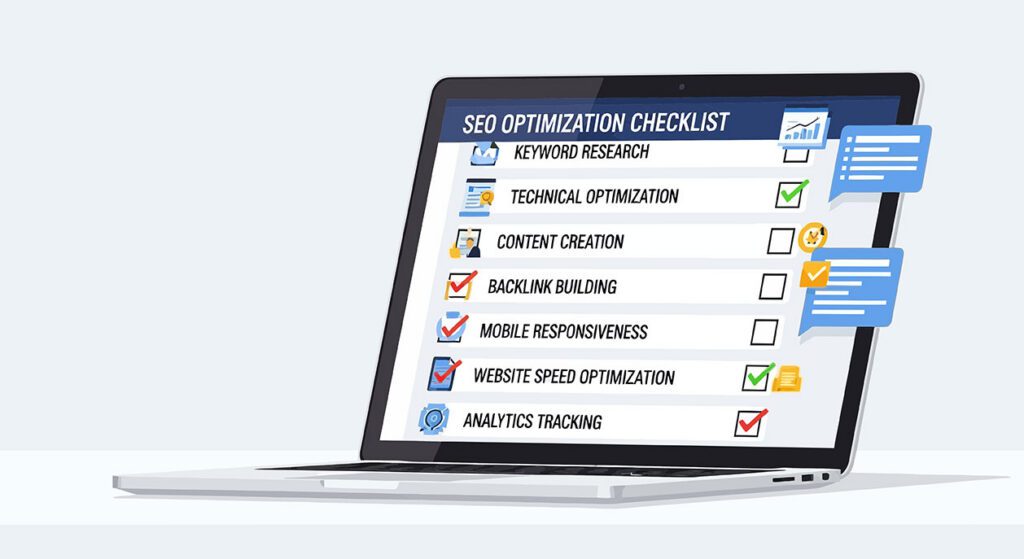
With the advent of AI search, search engines are now much more adept at evaluating content and user experience through non-traditional on-page signals. The following technical SEO checklist for 2026 can help your business understand what search engines consider important to get cited in Google AI summaries.
Today, rankings are not about fixing every SEO issue, but fixing what’s impacting visibility. If your website has problems with crawlability, this will inevitably affect how Google decides to rank or cite your website in AI search summaries.
Use our technical SEO checklist to improve the tech-end of your website and help users discover and interact with your content!
The Importance of Content Crawlability for SEO
Audit Robots.txt and Crawl Directives
The robots.txt file and other crawl directives tell the search engine details about your website, which makes the crawling of your website possible. The robots.txt file is a simple text file that is located in the root directory of your website and should be monitored in case it is blocking important pages accidentally.
In addition to these files, it is also necessary that access to CSS and JavaScript files is also available for search engines to crawl.
Fix Broken Internal Links and Orphan Pages
Internal links can break whenever you change the URL name of your links or delete pages that no longer align with your business needs. When this happens, your links could lead to 404 errors that disrupt your site’s SEO leverage.
Orphan pages also get penalized by search engines, so make sure that all of your website pages are internally linked to other pages so that SEO authority is distributed among all the pages.
Think of internal links as bridges of authority, and the presence of orphan pages as a way for the SEO value to get diluted.
In order to avoid broken links, you’ll need to conduct an audit and use redirects where necessary. Similarly, ensure that you minimize the number of redirects, since this will slow down the crawl process.
Finally, to address the issue of orphaned pages, go over each of your website pages and check whether they connect to other internal pages.
Overall, by adding more internal links to content, you will improve your site’s indexing and discoverability.
Simplify Site Architecture
Your site architecture is the blueprint Google and other search engines use to understand what your website is about and when to present it to users. Keep your architecture easy to navigate and your most important pages no more than three clicks away from your homepage.
Decluttering and simplifying your website so that it is user-friendly and easy to crawl is at the top of the technical SEO checklist for 2026.
Another tip is to link your internal pages with intent and logic. For example, make sure that only related pages are connected to each other to strengthen topical relevance.
Resolve Indexing Issues Before Creating More Content
Compare Indexed Pages vs Submitted Pages
More content doesn’t necessarily mean better rankings and greater SEO leverage.
Indeed, only content that search engines rank matters, and you should begin by addressing any problems that hinder your content’s crawlability and indexing.
For example, you can begin by examining your indexed pages versus the ones you have submitted to see where the problem lies in terms of content quality, or find solutions for pages that have not been indexed yet.
Google Search Console will help you analyze the XML sitemap frequently for indexing issues, such as thin and duplicate pages.
Fix Duplicate Content and Canonical Conflicts
Canonical issues are at the core of the technical SEO checklist. Duplicate content confuses search engines and weakens the authority of the other website pages.
The most common mistake is marking the wrong version of the page as the “preferred” page or assigning no canonical tag to pages at all, which leads to the indexing of multiple versions of the same content.
Another issue that can waste the crawl budget of your website is parameter URLs that track or filter different versions of your content. You can counteract this problem by setting correct canonical tags that ensure that only the main version of a page is indexed.
Remove or Improve Low-Value Pages
Another way to help search engines find and index your pages is to identify and improve the pages that don’t add SEO value to your website. To do so, you can add additional content that highlights your expertise (think E-A-T) and review that your content strategy is fully optimized for AI search.
You can also choose to delete the content, but be cautious that this won’t lead to more broken links. Another possibility is to set your content to “noindex”, which will prevent search engines from scanning and indexing it.
Optimize Core Web Vitals & Site Performance SEO
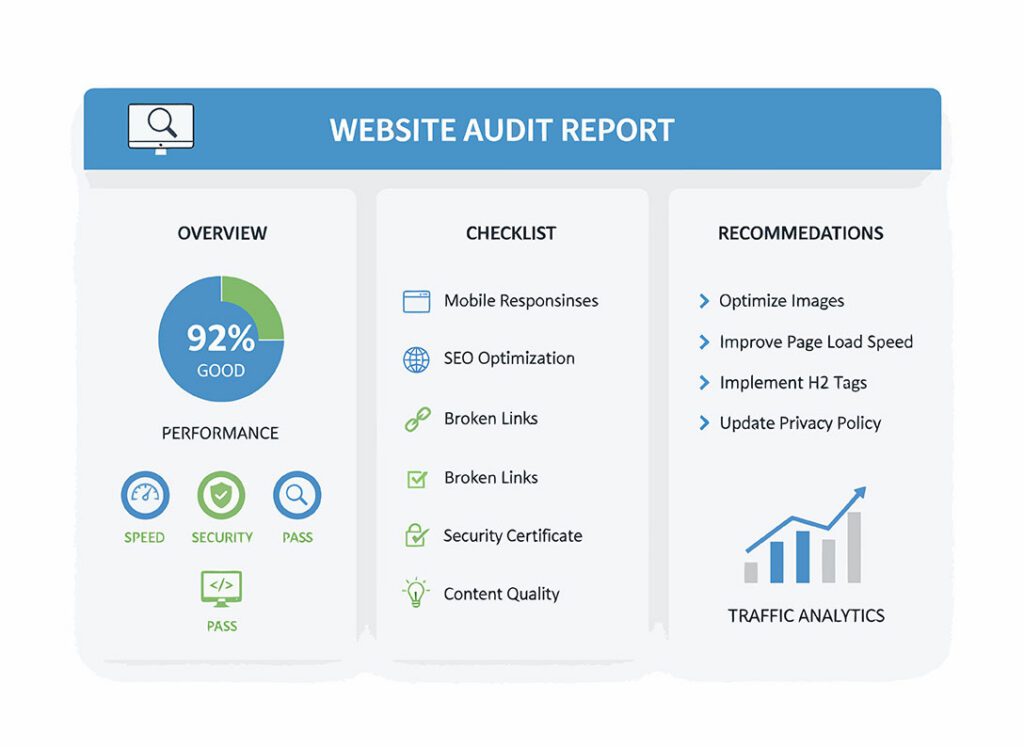
The Core Web Vitals have a significant impact on website performance and should be optimized for SEO leverage. The following are the most important Core Web Vitals to focus on to ensure your website is ranked competitively.
But remember, today’s SEO landscape is not centered on clicks and rankings, but around AI search citations. Due to an increase in zero-click searches, the best strategy for businesses is to be mentioned by Google AI search results for relevant user queries.
Improve Largest Contentful Paint (LCP)
Largest Contentful Paint measures how long it takes for the biggest piece of content to load on a page.
Since speed is a big aspect of SEO performance, improving LCP by compressing images and decreasing server response time will go a long way to improve your site’s performance.
Reduce Interaction Delays (INP)
Interaction to Next Paint (INP) measures the reaction speed of your website when someone clicks on a link or types a response.
Therefore, if there are too many scripts and third-party tools running simultaneously, the site can seem too slow and outdated. This detracts from user experience and signals poor website performance.
Prevent Layout Shifts (CLS)
Cumulative Layout Shift (CLS) measures how much a page visually shifts around while it’s loading. To prevent this bouncing, set the correct width and height attributes for all images.
Validate Mobile-First Rendering
Since most B2B and B2C purchasing is currently done with mobile devices, it is vital that your website is built and tested for them.
Mobile-first rendering includes using a responsive design that adapts layout features to various screen sizes. This also guarantees that pages will load fast and will be easy to navigate.
Technical SEO Experts
At CloudMellow Marketing, we understand how SEO has evolved and why long-held methods no longer help businesses achieve the rankings they seek.
That is why our SEO experts will work with you one-on-one to ensure your website is optimized with the most up-to-date technical SEO checklist that will increase your chances of being cited by AI search engines.
If you’re looking to revamp your outdated SEO strategy, contact us today!