How to Choose a Web Design Agency That Drives Revenue, Not Just a Better Website


By Cloudmellow Updated September 2, 2026 Technical Review Verified
14 Min Read
Team using a laptop

Overview

A website redesign changes far more than a company’s visual identity. It can alter how buyers research an offer, how search engines understand the site, how leads reach sales, how marketers publish content, and how performance is measured. A polished interface matters, but visual quality cannot compensate for broken journeys, weak information architecture, risky migrations, disconnected systems, or missing ownership after launch.

Choosing a web design agency therefore requires a business case, not a beauty contest. The strongest partner will translate an objective into audience needs, technical requirements, measurable events, operating responsibilities, and a realistic post-launch plan. The evaluation should also leave room for a freelancer, an internal team, or a hybrid model when those options fit the problem better.

Why Choosing the Right Web Design Agency Matters More Than Ever

B2B buyers often form strong vendor preferences before speaking with sales. In a 2025 study of nearly 4,000 buyers across North America, APAC, and EMEA, 6sense found that the winning vendor appeared on the buyer’s Day One shortlist 95 percent of the time. Gartner separately reported that 61 percent of 632 surveyed B2B buyers preferred an overall rep-free buying experience, while buyers still favored seller input for questions about contextual fit.

Neither study proves that a website causes a buying decision. Together, they show why a company’s digital presence must support serious self-directed diligence. Buyers need clear positioning, credible proof, useful technical information, and consistent answers across the website and sales team. They also need a sensible path to human guidance when generic content cannot resolve a question.

Search discovery is changing as well. Google’s AI Overviews and AI Mode can introduce additional paths to a company’s content, but the current guidance does not call for a special AI schema or machine-readable AI file. Crawlability, useful text, internal links, visible evidence, and sound page experience still matter. A capable website design agency should understand those established requirements without presenting speculation as a guaranteed visibility strategy.

Agency selection affects all of these jobs. It shapes brand trust, buyer self-service, demand capture, search continuity, data quality, and the speed at which the marketing team can respond after launch. Website design services should therefore be assessed within the wider commercial and operating system, not as an isolated creative purchase.

What Does a Modern Web Design Agency Actually Do?

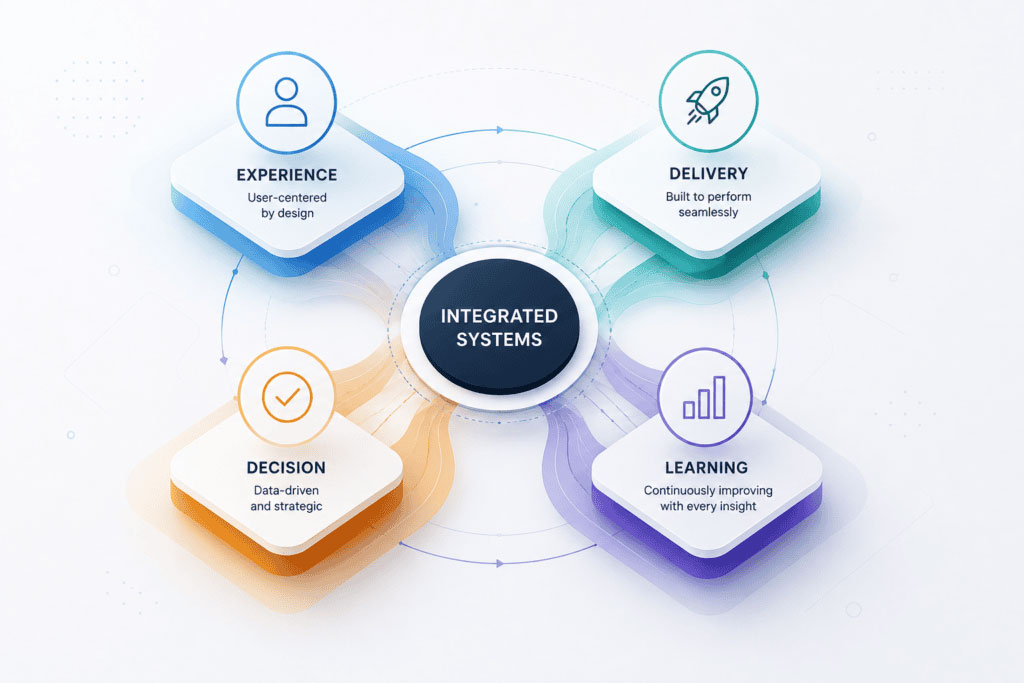
“Full service” says little unless the responsibilities underneath it are clear. A modern agency may coordinate four connected systems, although the exact scope should reflect the assignment.

The decision system connects business objectives to audience research, customer journeys, content priorities, requirements, and success measures. Useful outputs include a research summary, journey maps, a measurement plan, and a prioritized backlog. The important question is who turns research into decisions and approves them.

The experience system covers information architecture, UX, UI, messaging, responsive design, and accessibility. Buyers should ask how the team validates navigation and critical tasks, not merely how it presents design concepts. Accessibility evaluation also needs an explicit standard, scope, and method. W3C notes that automated tools can assist an evaluation but cannot determine conformance on their own, so knowledgeable human review remains necessary.

The delivery system includes CMS architecture, front-end and back-end development, integrations, security, performance, technical SEO, migration, and quality assurance. Strong website development and integration capabilities become particularly important when forms, product data, marketing automation, HubSpot, Salesforce, customer portals, or internal systems must exchange reliable information. A custom web design does not require custom code everywhere. It requires deliberate choices about what should be configured, extended, integrated, or built.

The learning system defines GA4 events and key events, Search Console monitoring, CRM handoffs, reporting, CRO, maintenance, and optimization. It also identifies who owns the backlog after launch.

These systems rarely sit with one person. The buyer needs a responsibility map that shows which capabilities are in-house, which are provided by specialists, what the client must supply, and how decisions move between teams. Integrated digital strategy has practical value only when those interfaces are visible.

Integrated Systems: Experience, Delivery, Learning and Decision

Signs It’s Time to Hire a Web Design Agency

A calendar is a poor trigger for a website redesign. The better question is whether the current site still supports the business, its audiences, and the team operating it.

Market and experience signals include a brand that no longer matches the company’s direction, navigation that obscures important offers, mobile friction, or accessibility problems across templates. Discovery signals may include weakening organic visibility, poor field performance, an architecture that cannot support new products, or content that is difficult to evaluate.

Operating signals are often more decisive at larger organizations. Marketers may need developers for routine publishing. Forms may send incomplete data into the CRM. Acquisitions can leave the company with overlapping domains, inconsistent brands, and unclear ownership. Unsupported plugins, fragile integrations, or a growing maintenance burden can turn ordinary updates into risk events.

The intervention should match the failure mode:

  • Optimize when the brand, platform, and core architecture still work but key journeys or templates underperform.
  • Redesign when the experience, brand expression, content structure, or component system no longer fits.
  • Replatform when the CMS or technical stack blocks required workflows, security controls, integrations, or scale.
  • Consolidate when multiple sites, brands, or content repositories create governance and measurement problems.

An agency is most useful when the work crosses disciplines or requires sustained coordination. A narrow template update may not need one. Defining the problem first prevents a web design company from prescribing the engagement it happens to sell.

How CMOs Evaluate a Web Design Agency

Portfolio quality belongs in the evaluation, but it is only the start. CMOs need to understand how an agency reasons, what evidence it creates, how it handles risk, and what the client will own.

Business case and measurement

A strong answer connects each objective to a buyer or internal use case, a requirement, an instrumented event, a downstream business metric, and an owner. Ask to see a sample measurement plan or anonymized reporting structure. A vague promise to “increase engagement” is a red flag if the agency cannot say which behavior matters or how it connects to pipeline, revenue, service, or operating efficiency.

Research and experience

Look for a method proportionate to the stakes. Relevant artifacts may include interview guides, analytics findings, journey maps, content inventories, task flows, accessibility requirements, and usability findings. The agency should explain how research changes information architecture and design decisions. Personas created without evidence and wireframes that appear before the team understands critical journeys suggest that the process is running on assumptions.

Technical architecture and CMS fit

Ask how the website development company will validate the CMS, integration pattern, component model, hosting, and deployment process. A strong response covers editor workflow, permissions, content reuse, security, scalability, performance, developer dependency, and total cost of ownership. Request a CMS editing demonstration before the architecture is locked.

SEO and migration risk

The diligence conversation should cover the URL inventory, content decisions, redirect map, canonicals, internal links, structured data, staging controls, sitemap, launch validation, and monitoring. Google warns that significant site changes can produce temporary ranking fluctuations while pages are recrawled and reindexed, so no agency can responsibly guarantee a fluctuation-free launch. Ask who owns the migration artifacts, who validates redirects at scale, and what happens when Search Console exposes an issue. A buyer who needs deeper implementation criteria can use a current technical SEO checklist to probe the proposed workstream.

Accessibility and quality assurance

Require the agency to state the targeted WCAG version and level, the templates and journeys in scope, the mix of automated and human testing, the assistive technologies or keyboard tests used, and how defects will be documented. Ask for the browser and device matrix, acceptance criteria, defect priorities, and launch authority. A scanner score presented as proof of legal compliance is not an adequate plan.

Proof, team, governance, and ownership

Review relevant web design and development work, then ask for the baseline, intervention, timeframe, data source, and limitations behind a relevant case. Meet the people who will lead the work. Confirm subcontractor roles, capacity, escalation paths, decision rights, and change control. Contract review should establish ownership and access for the domain, hosting, analytics, designs, content, code, accounts, documentation, and licensed components.

The evaluation is strongest when it follows one evidence chain:

Business objective → audience job → required capability → deliverable → instrumented event → CRM stage → pipeline or revenue measure → review owner and cadence

An agency does not need to control every link. It does need to identify where its evidence ends, where client data begins, and which assumptions could weaken the conclusion.

Web Design Agency vs. Freelancer vs. In-House Team

The best model depends on the breadth of work, continuity required, internal leadership capacity, and cost of coordinating specialist gaps. A B2B web design agency often suits a cross-functional transformation, while a skilled freelancer can be the better choice for a narrow problem. An internal team offers persistent context and ownership but may still need outside capacity or specialist review.

Decision factor Agency Freelancer In-house team
Strategy Cross-functional perspective when senior strategy is truly staffed Strong for a defined specialty, dependent on the individual Deep company context, with risk of internal assumptions going unchallenged
Scalability Can add disciplines and parallel capacity Limited by one person’s time and network Stable capacity but slower to expand for a temporary program
SEO expertise Can integrate content, technical SEO, and migration Excellent if the freelancer is a specialist Strong when dedicated expertise exists and has launch authority
UX Research and design coverage can be coordinated Effective for focused research or interface work Benefits from ongoing customer knowledge but may lack research capacity
Development Broader architecture, QA, and integration coverage Efficient for a well-bounded build Best for long-term product continuity when adequately staffed
Analytics Can design instrumentation across site and campaign teams Suitable for defined implementation or analysis Close to CRM and finance data, though ownership may be fragmented
Long-term support Available through a retainer or support agreement Depends on availability and continuity Persistent ownership is a core advantage
Overall value Strong when coordination and risk reduction justify the fee Strong when scope is narrow and client management is available Strong when web work is continuous and strategically central
Total cost of ownership Includes fees, change control, client time, platform, support, and exit terms Includes management time, specialist gaps, continuity, and rework risk Includes salaries, recruiting, tools, management, training, and unused capacity
Designer at work

Designer at work

Hybrid models are common and often sensible. An enterprise web design agency might lead research, architecture, migration, and the initial build while an internal team owns content and optimization. A freelancer might provide specialist accessibility or technical SEO review. The model should make accountability clearer, not create more handoffs than the project can manage.

What Makes a Revenue-Driven Web Design Agency Different?

A revenue-driven agency does not label every website metric as revenue. It begins with the business outcome and works backward to the journeys, content, system behavior, and data needed to evaluate progress.

Consider a company that wants more qualified opportunities from a complex product portfolio. A useful plan would define which audiences and use cases matter, what content supports their evaluation, which actions indicate meaningful intent, how forms and routing capture that context, where the CRM records acceptance or rejection, and how the team will review pipeline quality. Pageviews, rankings, engagement, and Core Web Vitals can help diagnose the system, but they do not prove ROI on their own.

Integration capability matters because the evidence chain crosses tools. A form submission may need campaign and content context, a reliable identity, territory rules, consent handling, and a CRM stage. The Varsity Spirit website project offers one concrete example of persona research, smart contact routing, and Salesforce data integration serving a broader site experience. It demonstrates the kind of connected capability a buyer can examine without implying that every project needs Salesforce or the same architecture.

Revenue discipline also appears in the operating model. The agency should define a measurement baseline before launch, document assumptions, establish an optimization backlog, and agree on who will interpret results. Good analysis acknowledges attribution limits. GA4, advertising platforms, CRM records, and finance data each answer different questions, and none automatically establishes causal lift.

Common Mistakes Companies Make When Hiring a Web Design Agency

The most visible mistake is selecting a portfolio instead of a team and method. Beautiful work can coexist with weak discovery, inaccessible components, fragile code, or poor measurement. Buyers should verify who did the relevant work and which people will serve the new account.

Other expensive mistakes appear earlier in procurement:

  • Starting an RFP before aligning on outcomes, constraints, stakeholders, and decision rights.
  • Comparing headline prices without normalizing content, migration, integrations, testing, hosting, maintenance, licenses, and internal effort.
  • Treating SEO, analytics, accessibility, content, or security as checks performed after design approval.
  • Accepting a preferred CMS before documenting publishing, governance, integration, scalability, and support requirements.
  • Leaving ownership, account access, documentation, warranties, service levels, and exit terms ambiguous.
  • Planning launch as the end of the program rather than the beginning of measured operation.

Agencies need access to current analytics, search data, CRM definitions, content inventories, and system constraints to assess feasibility. A proposal built on missing inputs should state assumptions clearly rather than disguise them as certainty.

How to Measure ROI After Launch

Measurement should be designed before the site is built. Otherwise, the organization may launch with attractive dashboards that cannot answer whether the investment improved a buyer journey, pipeline quality, or operating efficiency.

Use four levels of evidence:

  1. Diagnostic metrics reveal site health and friction. Examples include crawl errors, accessibility defects, form failures, Core Web Vitals, uptime, and task completion.
  2. Marketing metrics show discovery and meaningful behavior, such as qualified organic visits, content use, GA4 key events, return visits, and conversion rate for a defined audience.
  3. Pipeline metrics connect website activity to company-defined stages, including accepted leads, opportunities, stage progression, sales-cycle length, and pipeline value.
  4. Revenue and operational metrics include attributable or incremental gross profit, customer value where appropriate, cost to serve, publishing time, support demand, and maintenance cost.

Google Analytics allows teams to mark important interactions as key events, but an event count is only the beginning of the analysis. Identity gaps, consent choices, offline activity, CRM discipline, attribution models, and lookback windows affect what can be observed. Reporting should disclose those boundaries instead of converting an attributed path into proof of causation.

A practical framework is:

Website investment return = agreed incremental gross profit or attributable value minus total website investment, divided by total website investment

The numerator and denominator need definitions. Total investment may include agency fees, internal labor, content, software, hosting, maintenance, training, and transition costs. An organization using revenue rather than gross profit should make that choice explicit. Operational gains may require a separate value model.

Set a baseline window, annotate launch and major campaigns, segment audiences, and assign an owner to each metric. Review diagnostic signals quickly, pipeline measures on a cadence that reflects the sales cycle, and revenue evidence only when enough data has accumulated.

What the Best Web Design Process Looks Like

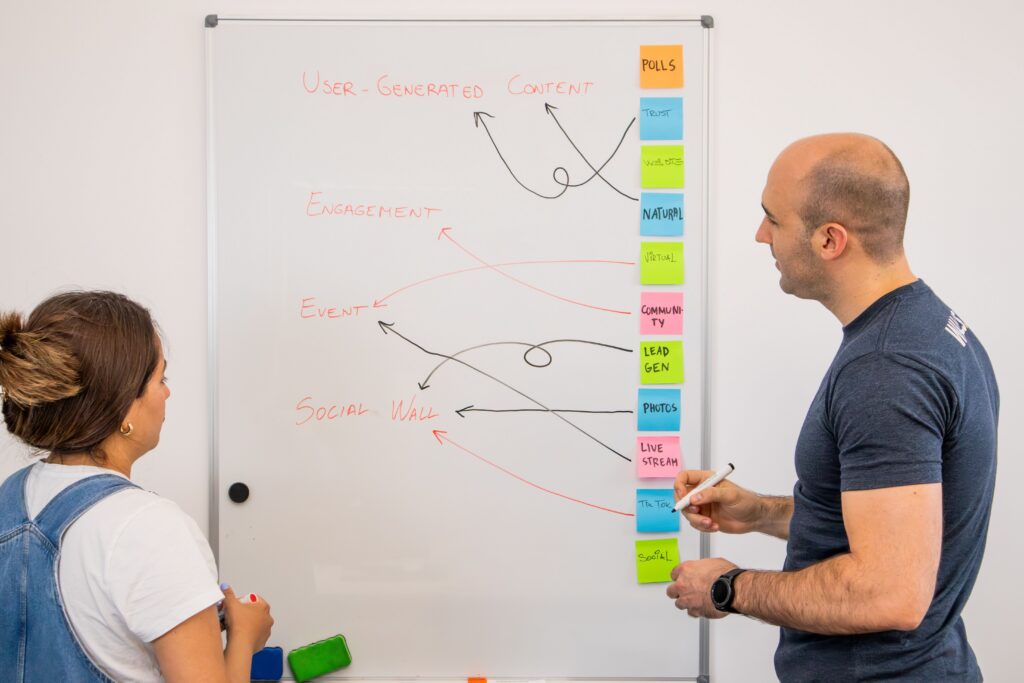
Team using whiteboard

Strong projects have visible decisions, dependencies, and approval gates. They do not force every workstream into a rigid waterfall. Content discovery can begin while research is underway, technical spikes may inform strategy, and development can start on approved components while later templates are refined.

The following timeline gives a designer an implementation-ready sequence. Parallel work should be shown as overlapping bands rather than a single row of boxes.

Phase Core decision or output Typical overlap or gate
Discovery Objectives, constraints, stakeholders, data access, decision rights Opens research, analytics review, and technical discovery
Research Audience evidence, analytics findings, content and technical inventories Informs strategy and continues into early architecture
Strategy Prioritized journeys, requirements, measurement plan, roadmap Gate for scope and solution direction
Information Architecture Sitemap, taxonomy, navigation, URL and content model Overlaps content planning and technical architecture
Wireframes Page purpose, hierarchy, components, interactions, conversion paths Gate for high-risk templates and usability checks
Content Development Messaging, page copy, metadata, migration decisions Runs alongside wireframes, design, and CMS preparation
Visual Design UI system, responsive behavior, component states, accessibility intent Approved components can move into development
Development CMS, components, integrations, tracking, performance, environments Proceeds in increments with technical QA
Quality Assurance Functional, responsive, browser, content, accessibility, and integration testing Continuous during development, then formal acceptance
SEO Review Redirects, canonicals, internal links, metadata, structured data, crawl controls Begins during planning and intensifies before launch
Launch Deployment, redirect activation, analytics validation, crawl and form checks Requires launch authority, rollback plan, and monitoring
Continuous Optimization Defect resolution, reporting, experiments, content and platform backlog Ongoing operating cycle after stabilization

Each gate needs an approver and acceptance criteria. Scope changes should record effects on timing, budget, and dependent work. Post-launch responsibilities should be agreed before deployment, including website hosting and ongoing management, incident handling, backups, security updates, analytics ownership, and the optimization backlog.

Questions to Ask Before Hiring a Web Design Agency

Use the following as an executive checklist during proposal review and finalist interviews. A strong answer should name the artifact, owner, assumption, or control rather than rely on a broad assurance.

  • Business strategy How will objectives become prioritized audience journeys, requirements, and measures?
  • SEO Who owns the content and URL inventory, redirect map, staging controls, launch validation, and Search Console monitoring?
  • Accessibility Which WCAG target and testing scope will apply, and where will knowledgeable human evaluation supplement tools?
  • CMS selection How does the recommendation fit editor workflow, permissions, integrations, security, scalability, and developer dependency?
  • Security Which party owns access control, patching, vulnerability response, privacy inputs, and third-party risk?
  • Hosting What environments, backups, monitoring, recovery targets, deployment controls, and performance responsibilities are included?
  • Analytics Which events, key events, identities, CRM handoffs, and validation procedures will be implemented?
  • Reporting Which diagnostic, marketing, pipeline, revenue, and operational metrics will be reviewed, by whom, and how often?
  • Website ownership Who controls the domain, hosting, accounts, designs, code, data, licenses, repositories, and documentation?
  • Ongoing maintenance What is covered after launch, what is billable, and how are defects distinguished from enhancements?
  • Post-launch support What are the support channels, response expectations, escalation path, knowledge-transfer plan, and exit terms?

Ask finalists to apply their answers to one real journey or integration. Specificity separates an operating plan from a polished sales narrative.

Frequently Asked Questions